Over 11,600 calls to the Elderly Helpline in 2025. 5,700 elderly people supported nationwide. 2025 annual statistics

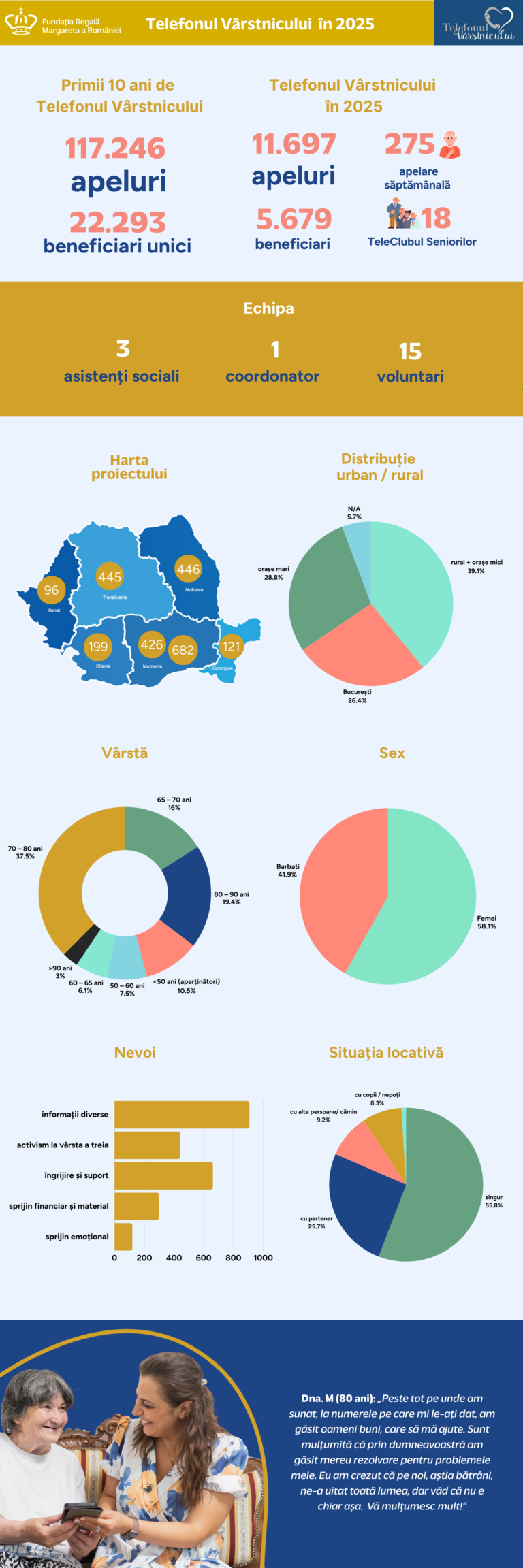
Bucharest, January 20, 2026 | In 2025, The Elderly Helpline – 0800 460 001the national toll-free line dedicated to elderly people, recorded 11,697 calls and it served as a trusted voice for 5,769 elderly people across Romania, confirming its essential role as a tool for support, information and connection for seniors nationwide.
- Key data in 2025
Throughout the year, the service reached 2,582 new callers and and 2,912 recurring callers – individuals already in the database Elderly Helpline, who reached out again during 2025 to request further informations highlighting the consistent and relational nature of the service. 275 elderly people were enrolled in the weekly call-back service, which aims to alleviate loneliness. Also, 15 volunteers were actively involved, primarily focusing on the weekly call-back initiative.
- Profile of new callers in 2025
The segmentation outlines a clear profile of the elderly people who called this service, highlighting both vulnerabilities and the increased need for information and structured support.
Regarding the gender distribution, 58% of new callers were women (1.500), compared to 42% men (1.082 – a slight increase from the previous year), confirming the constant trend that elderly women reach out more frequently to support and counseling services.
The analysis of the living situation shows a high level of loneliness: 56% of elderly people live alone (1.441), while 26% live with a partner (663). A smaller number live with other people (238) or with children and grandchildren (214), which underscores the fragility of family support networks at advanced ages.
Regarding age category distribution, the dominant segment – at 38% – is that of elderly people aged between 70 and 80 years old (969), followed by the 80 – 90 age group – 19% (500) and 65 – 70 years old – 16% (413). Additionally, the presence of callers under 50 years old (271) indicates the involvement of caregivers requesting support and information on behalf of elderly people, while the over 90 years category (78) reflects situations of heightened vulnerability.
From the perspective of place of residence, most callers – 39% – come from rural areas and small towns (1.010)followed by large cities (743) and Bucharest (682), which confirms unequal access to specialized services and the necessity for interventions at a national level.
At the geographical distribution level, Bucharest concentrates the highest number of callers (682), followed by Moldavia (466), Transylvania (445) and Muntenia (426), with lower values in Oltenia (199), Dobrogea (121) and Banat (96), shaping an extensive coverage across the entire country.
- Main needs expressed by new callers
Regarding the needs of elderly people, they predominantly requested diverse information concerning rights, services, and social guidance. 907 elderly people obtained free and easy relevant contacts and updated information for particular situations from the specialized team. The social workers of the telephone line operate with a database containing approximately 1,500 state institutions, social services or private entities with specific services for seniors, which is continuously updated.
The need for care and support depending on the degree of dependency remained in second place. Information about available specialized services, references regarding care homes for elderly people and institutionalization procedures, and resources available in the community, as well as recommendations regarding institutions offering home medical care, were received by 661 of the elderly people.
The interest of seniors in being active and participating in the community after retirement indicates the desire to remain active in the community after retirement. 441 elderly people learned at the Elderly Helpline about possible opportunities to participate in digital education workshops for seniors organized in Bucharest and 15 other localities in the country, about volunteering opportunitiessuch as The Generations Centres,, or about activities organized in senior clubs in the community or at the the Seniors’ TeleClub.
In fourth and fifth place are requests from elderly people for financial and material support (298), as well as and emotional support (120), reflecting social and emotional realities that require integrated and sustainable interventions. The project team recommended appropriate community resources for individual needs to them, operated by Social Assistance Directorates (DGAS) or NGOs, which can provide food products, hygiene items, or social vouchers. For the latter category, the team responded through its own weekly call-back services or by redirecting them to partner organizations with specialized services in their community.
Field testimonies – the human impact of the service
,,When you call me, you make me cry, but out of joy. Generally, I feel like I belong to no one, I am 88 years old, I haven't had a husband in 13 years, and my two children have died. I am completely alone. You feel a great pain as a human being to reach an age where no one crosses your threshold or even gives you a phone call. You offer me solace, you show me that someone still cares about elderly people.” – Mrs. G, 88 years old
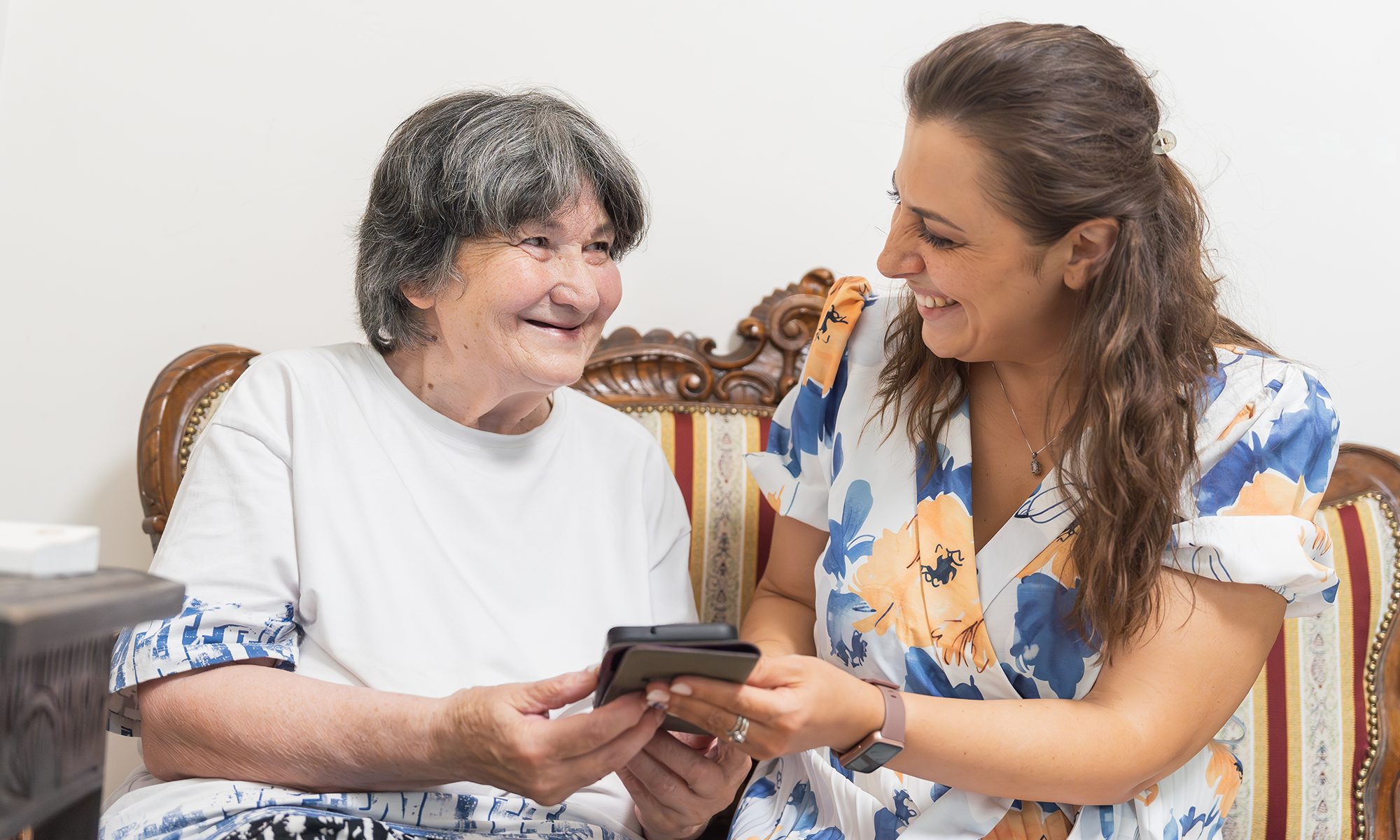
,,Everywhere I called, at the numbers you gave me, I found good people to help me. I am satisfied that through you, I have always found a resolution for my problems. I thought that everyone had forgotten about us, the elderly ones, but I see it’s not quite like that.” – Mrs. M, 80 years old
10 years after the launch of the toll-free line, Elderly Helpline asserts itself as a pillar of social stability, a trusted channel, and a voice for Romania’s seniors, demonstrating that the tradition of caring for elderly people can be sustained through modern solutions, empathy, and solid partnerships. Over all these years, the team of social workers has responded to approximately 117.300 calls, providing guidance and solutions for the needs of about 22.300 unique beneficiaries from all regions of the country.
Calls to Elderly Helpline can be made for free at 0800 460 001, from Monday to Friday between 08.00 – 20.00 and Saturday between 08:00 – 16:00.
Elderly Helpline is a social project supported in 2025 by Kaufland Romania, Johnson Wax, Yardi Romania, the Romanian National Lottery Company and Synevo Romania.
Media support was provided by:
TV – Pro TV, TVR, Antena 1, Antena 3 CNN, Antena Stars, Prima TV, Prima News, Pro Cinema, Pro Arena, Acasă, Acasă Gold, Trinitas TV, Speranța TV, Antena 3 Deva, Campus TV Buzău, City TV Tg Mureș, Exploris TV, Moldova TV & Zenith Media (TV spot at Digi 24, Digi Sport, Pro TV group, Prima TV group, Antena 1, Antena 3 CNN, Euronews, Favorit TV, Hit Music, Music Channel, N24 Plus, National TV, Romania TV, U TV, Zu TV, Happy Channel, Thematic Channels etc & radio spot at Radio Guerrilla, Digi FM, Pro FM, Viva, Radio Transilvania, Fresh, Eveniment / Sweet FM etc)
Radio – Radio România Actualități, Radio România Antena Satelor, Radio România Regional, Radio Trinitas, Radio Arad, Radio Boom România, Radio Campus Buzău, Radio Renașterea etc
OOH – Farmacia TEI, Kaufland România
Online/Print – AGERPRES, Rador, AmosNews, DCNews, Forbes Romania, Forbes Life, Nine O’Clock, Ziarul News, Ziarul Lumina, Europa Liberă România, BIZ, Ziarul Ultima Oră, Adplayers.ro, Future Economy, Formula AS, Asul Verde, România Pozitivă, Gala Societății Civile, România Responsabilă, Stiri.ong, Nonguvernamental.org, Jurnal de Sustenabilitate, Seniorul.ro, Crai Nou, Suceava News, Glasul Văilor, Viața Buzăului, Obiectiv Ialomița, Ghidul Banatului, Vocea Dâmboviței, Ziarul Clujean, Răsunetul etc
_______________________________________
About The Margareta of Romania Royal Foundation
Established in 1990 by Her Majesty Margareta, Custodian of the Romanian Crown, together with her father, King Michael, the Margareta of Romania Royal Foundation is today an elite non-governmental organization that supports children, youth, and elderly people through sustainable interventions based on the exchange of experience and values between generations. Throughout its 36 years of activity, the Foundation has developed numerous sustainable projects in the fields of education, community development, civil society, health, and culture—projects that have contributed to the spiritual and social renewal of Romania. The Margareta of Romania Royal Foundation supports elderly people through programs designed to increase their quality of life, with the involvement of volunteers and the mobilization of institutional partners and the entire community, the most recent being The Elderly Fund, The Elderly Helpline, Generations Community Centers, and Connecting Generations in the Digital World. More details are available at fundatiaregala.ro/.
About The Elderly Helpline
Established in 2015 as a response to the issue of aging, the social service Elderly Helpline maps and responds to the needs faced by Romania’s seniors, based on over 117,000 conversations and the requests expressed by over 22,000 unique callers, beneficiaries of the program, coming from all corners of the country. Burdened by loneliness, limited access to information, marginalization, worries, fears, material deprivation, or health problems, seniors call the toll-free number 0800 460 001 to find social counseling, a listening ear, consolation, and guidance.