100,000 conversations at the Elderly's Phone – a trusted friend for elderly people

- 100,000 heartfelt conversations and just as many solutions offered to elderly people in nearly 9 years of operation
- over 18,600 callers rang the Elderly Helpline for guidance and counseling
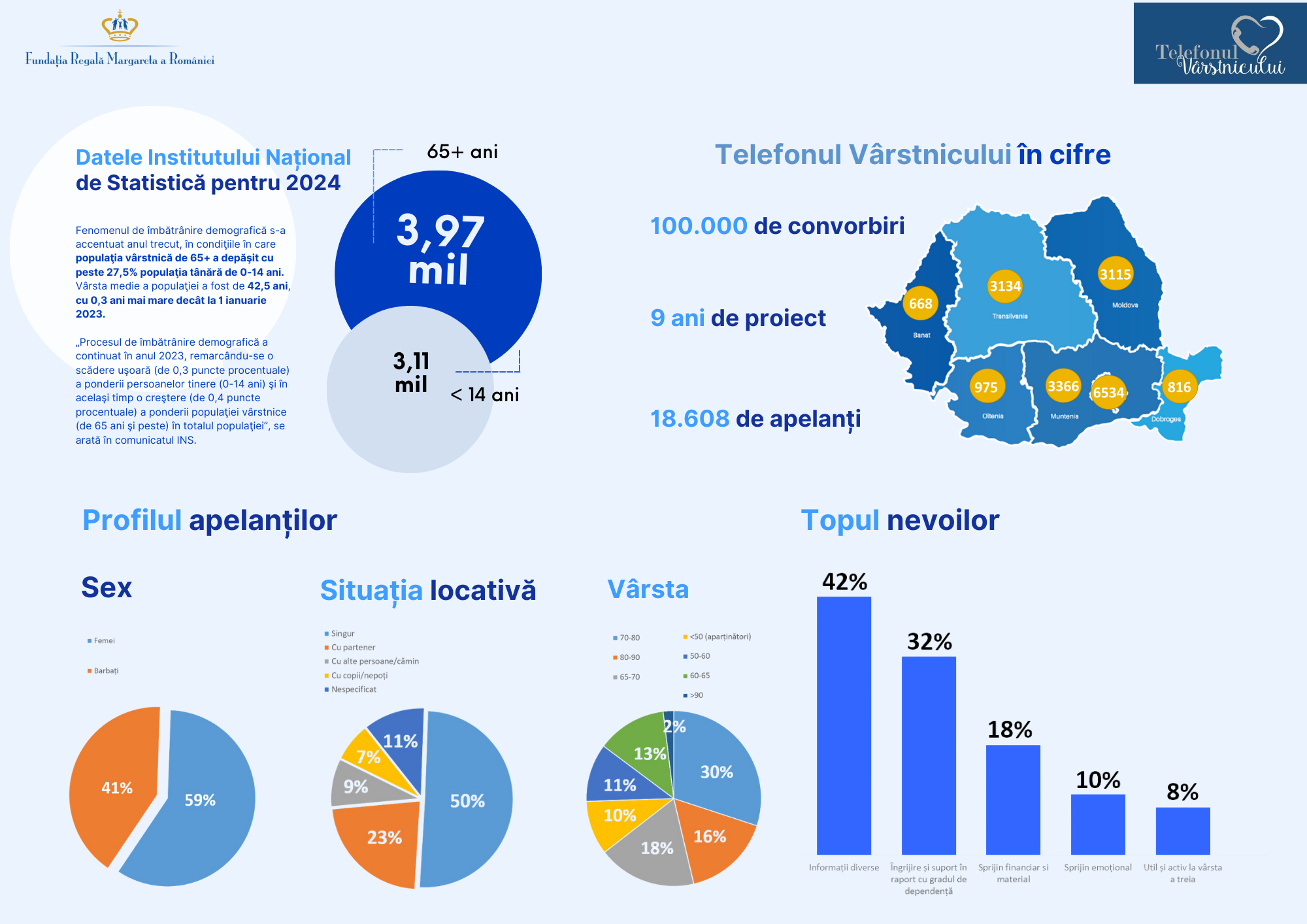
- 50% of callers live alone, 30% are between 70 and 80 years old
- Practical information and care services are at the top of the reasons for calling the Elderly Helpline îngrijire sunt în topul motivelor de apelare la Telefonul Vârstnicului
4 July 2024: The Elderly Helpline, the national toll-free telephone line dedicated to elderly people aged 65 and over, launched by the King Michael I Royal Foundation in October 2015, has reached 100,000 phone calls with elderly people and relatives across the country. At the toll-free number 0800 460 001, callers have benefited from social counselling, information, emotional support and guidance, provided with dedication by the Foundation’s social assistance operators, as well as by specially trained volunteers.
The Elderly Helpline was the first toll-free information and assistance line dedicated to people aged over 65 in Romania, licensed as a social service. In almost 9 years of activity, The Elderly Helpline has been contacted by 18,608 unique callers. Of these, 50% stated that they live alone, 41% requested practical and useful information to solve individual or day-to-day living issues, 32% were in need of care and support, having various degrees of dependency, and 30% were between 70 and 80 years old.
Elderly people who called The Elderly Helpline have always found a counsellor, a trusted interlocutor, a companion, a friend, being listened to and guided through individual life situations, benefiting from emotional support through weekly follow-up calls, group conversations and psychological counselling. This social service has created a map of social services and has become a valuable resource centre for seniors, regardless of the community they belong to, relying on a database of over 450 public institutions, non-governmental organisations and private services, and on a team of professionals specialised in ageing.
Relieving loneliness and encouraging an active lifestyle after retirement have been two of the directions supported by The Elderly Helpline. Thus, the telephone line has become a landmark for elderly people in our society, being the only national, toll-free and confidential line that has operated continuously, standing the test of time, supported through individual donations, company sponsorships and mass-media campaigns.
“Since its launch, The Elderly Helpline has represented an important step towards connecting as many elderly people as possible affected by isolation, loneliness, lack of reliable information, but also lack of support. What we set out to do in 2015, we continue to do today: to listen to the problems of elderly people in Romania, to offer them counselling and opportunities to participate in society and to make the most of their experience. At the same time, we continue to aim to mobilise local communities to remain united in supporting these people so that they are treated with the respect they deserve,” states Mugurel Mărgărit, Executive Director of The Margareta of Romania Royal Foundation.
The processing of the data collected through the telephone line during the period October 2015 – July 2024 reveals the top 5 most important needs faced by elderly people across all regions of the country and the solutions that The Margareta of Romania Royal Foundation and its partners have provided:
1. The Elderly Helpline was most frequently called to obtain useful, practical and up-to-date information regarding various needs of elderly people (7,635 persons). Elderly people obtained, easily and free of charge, relevant contacts and updated information for particular situations from the specialised team of social workers operating the telephone line. They work with a database containing over 450 public institutions, social or private services with specific services for elderly people. The highest number of people requesting information were from Bucharest (6,534 persons), and the lowest from Dobrogea (816 persons) and Banat (668 persons).
2. The need for care and support depending on the degree of dependency ranked second among the reasons for calling. 5,865 people received information about residential care homes for elderly people and institutionalisation procedures, practical services available in the community, as well as recommendations regarding institutions providing home medical care or meals on wheels.
3. Ranking third among the calls from elderly people were requests for financial and material support, from 3,256 elderly people. The team of The Elderly Helpline guided these elderly people towards appropriate community resources, operated by Social Assistance Directorates (DGAS) or NGOs, which can provide food products, hygiene items or social vouchers.
4. For 1,787 elderly people, The Elderly Helpline became a trusted friend and responded to the need for emotional support of those who struggle with loneliness, current social or personal challenges, through its own weekly follow-up call services and psychological counselling, provided free of charge by volunteer psychologists, or by referral to partner organisations with specialised services in their community.
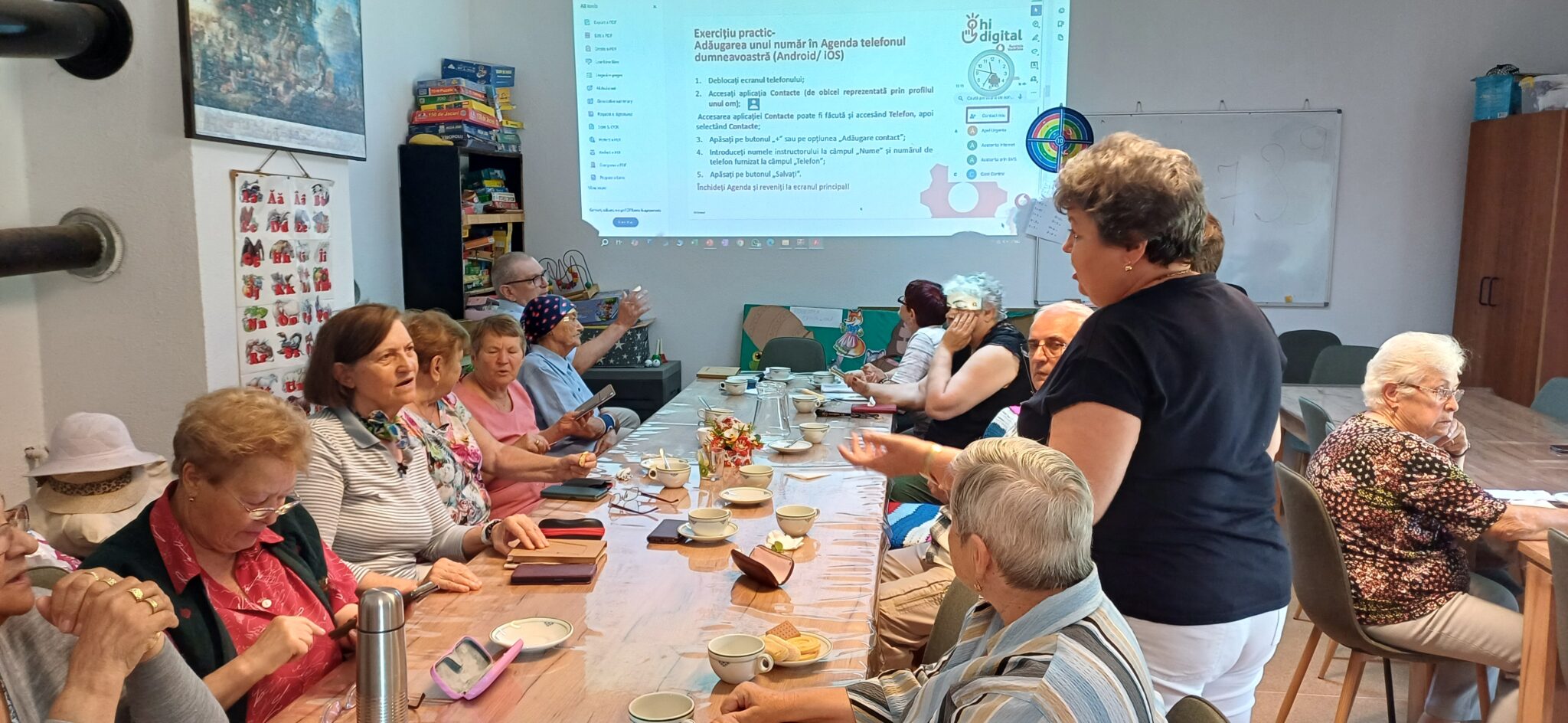
5. A total of 1,400 of the elderly people who called The Elderly Helpline during the mentioned period expressed their desire to remain active and to get involved in social life after retirement. They were offered information about volunteering opportunities in the community, such as the Generations Centres, about the possibility to participate in digital education workshops for elderly people organised in Bucharest and in 10 other localities across the country, in activities organised in community senior clubs or in the Seniors TeleClub, a virtual meeting space that allows elderly people to connect and share common experiences.
Romania’s population continues to age.
The demographic aging phenomenon intensified last year, as the elderly population aged 65 and over exceeded the young population aged 0-14 by more than 27.5%, according to data from the National Institute of Statistics. Additionally, the demographic aging index increased from 122, on January 1, 2023, to 127.5 elderly people per 100 young people, on January 1, 2024.
Calls to The Elderly Helpline can be made at the toll-free number 0800 460 001, Monday to Friday, between 08:00 – 20:00 and Saturday between 08:00 – 16:00.
The social project was launched in October 2015 in response to the issue of population ageing and benefited from funding provided by the Vodafone Romania Foundation. In 2024, the programme continues to be supported by the Vodafone Romania Foundation, together with the National Company “Romanian Lottery” and Johnson Wax.
****
About The Margareta of Romania Royal Foundation
Established in 1990 by Her Majesty Margareta, Custodian of the Romanian Crown, together with her father, King Michael, the Margareta of Romania Royal Foundation is today an elite non-governmental organization that supports children, youth, and elderly people through sustainable interventions based on the exchange of experience and values between generations. Throughout its 34 years of activity, the Foundation has developed numerous sustainable projects in the fields of education, community development, civil society, health, and culture, projects that have contributed to the spiritual and social renewal of Romania. The Royal Foundation supports elderly people through programs designed to increase their quality of life, involving volunteers and mobilizing institutional partners and the entire community, the most recent being the Elderly Fund, The Elderly Helpline and the Generations Community Centers. More details are available at fundatiaregala.ro/